Getting started
Install
AgentLens needs Python 3.11+. It is not on PyPI yet (v0.1.0 is next), so install it from source:
To use it in your own project instead: pip install agentlens-toolkit once it is released on PyPI,
or pip install "agentlens-toolkit @ git+https://github.com/ggbifulco/agentlens" until then (add
[otel] for the OpenTelemetry exporter). The distribution is called
agentlens-toolkit because agentlens is taken on PyPI; you still import agentlens.
Quickstart: catch a regression in four commands
Everything runs offline: the example support-desk agent uses a scripted mock model, so there is no API key to set and the numbers are the same on every machine. From the repository root:
# 1. Baseline: the reviewed prompt on the 27-case golden dataset, marked as the suite's baseline
uv run agentlens run examples/support_agent/suite.yaml --name main --set-baseline

# 2. Candidate: a "simplified" prompt that quietly drops the $200 refund limit
SUPPORT_PROMPT_VERSION=v2 uv run agentlens run examples/support_agent/suite.yaml --name prompt-v2

# 3. Compare with confidence intervals and quality gates; exits with 1 because a gate failed
uv run agentlens compare --candidate prompt-v2 --gates examples/support_agent/gates.yaml --html report.html

# 4. Open the self-contained HTML report
open report.html                   # Linux: xdg-open report.html · Windows: start report.html
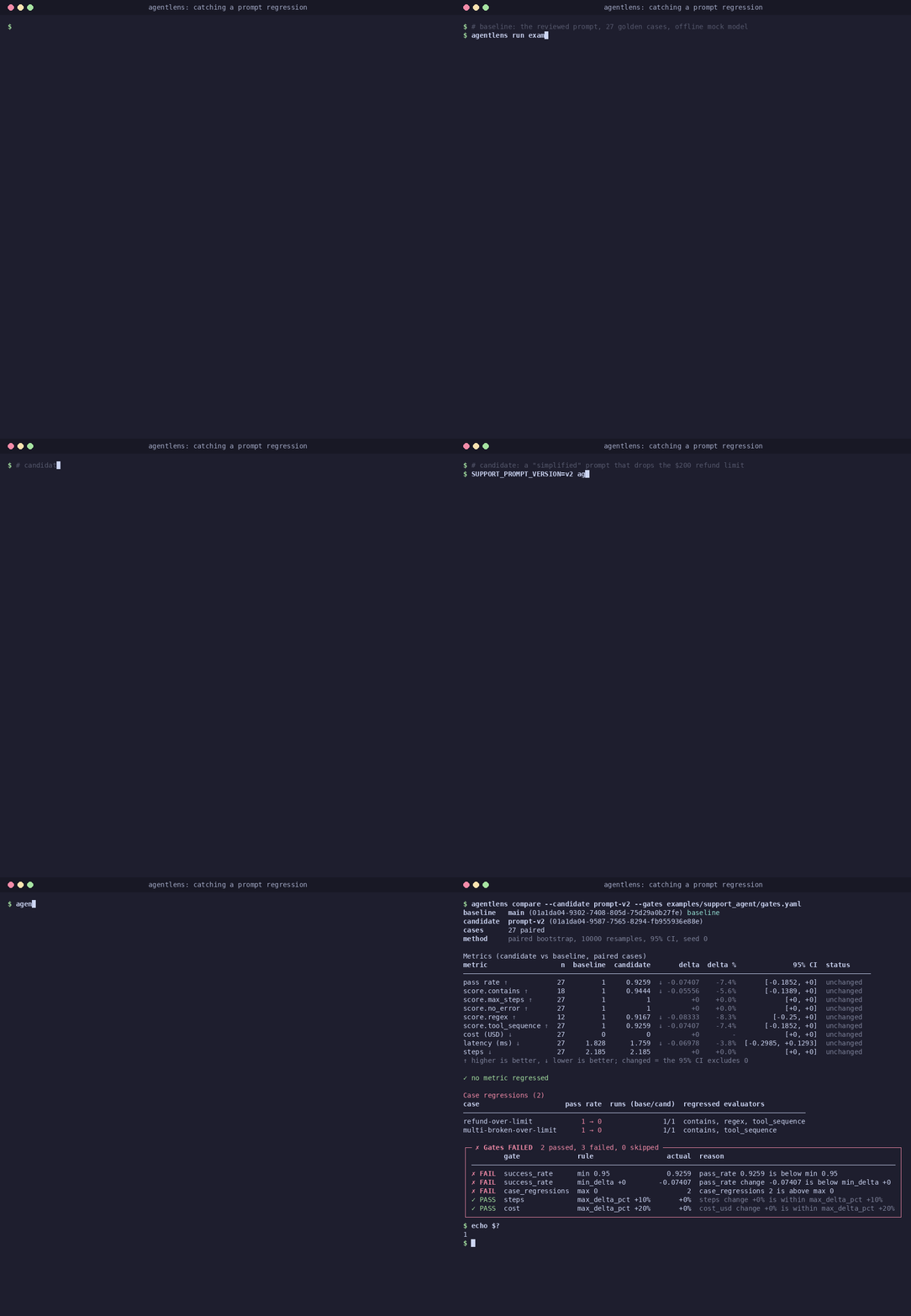
What happened:
agentlens runran every case, recorded each run as a trace (LLM calls, tool calls, latency, cost), scored it with the suite's evaluators and saved an experiment in.agentlens/agentlens.db. The baseline passes 27/27.- With the v2 prompt, 25/27 pass: the agent now refunds an $899 laptop instead of escalating it.
The answer still reads fine; the trajectory is wrong (
issue_refundis a forbidden tool for that case). agentlens comparepaired the two experiments case by case, computed every metric's change with a bootstrap confidence interval, listed the two case regressions and checkedgates.yaml:case_regressions: {max: 0}fails, so the exit code is1and a CI job would go red.- The HTML report shows every case side by side, regressions first, with a span-tree viewer for each trace.
Then try uv run agentlens ui to browse the same database in the web UI, and read the
regression story for the full walkthrough, including the CI side.
Test your own agent
Any Python callable that takes the case input works as an agent. Wrap its LLM client and tools so the runs are traced:
# echo_agent.py
import agentlens
from agentlens.llm import LLMRequest, Message, get_client

def run(question: str, model: str | None = None) -> str:
    llm = agentlens.wrap_llm(get_client(model or "mock"))   # "mock" echoes the question
    return llm.complete(LLMRequest(messages=[Message.user(question)])).content
Describe the cases and how to score them in a suite, and what "good enough" means in a gates file:
# suites/echo.yaml
name: echo
agent: echo_agent:run
repetitions: 3
defaults:
  evaluators: [no_error, exact_match]
cases:
  - {id: hi, input: "hi", expected: "hi"}
  - {id: bye, input: "bye", expected: "bye"}
# gates.yaml
success_rate: {min: 0.9}          # at least 90% of the runs pass
case_regressions: {max: 0}        # no case that passed on the baseline may fail now
uv run agentlens run suites/echo.yaml --name main --set-baseline
# ... change your prompt, model or code ...
uv run agentlens run suites/echo.yaml --name my-change     # --model openai:gpt-4o-mini: a real model
uv run agentlens compare --candidate my-change --gates gates.yaml
--model (or $AGENTLENS_MODEL) picks the model under test: mock, openai:...,
anthropic:..., ollama:... and other providers; real providers read
their API key from the environment.
Next steps
- In CI: the GitHub Action runs the suite on the PR's base commit and on the PR, posts the comparison as a PR comment and fails the job when a gate fails.
- Next to your tests: the pytest plugin turns each case into a test.
- Scoring: built-in and custom evaluators, LLM judges (and how far to trust them).
- Deterministic re-runs without API calls: replay cassettes.
- Every command and option: the CLI reference.